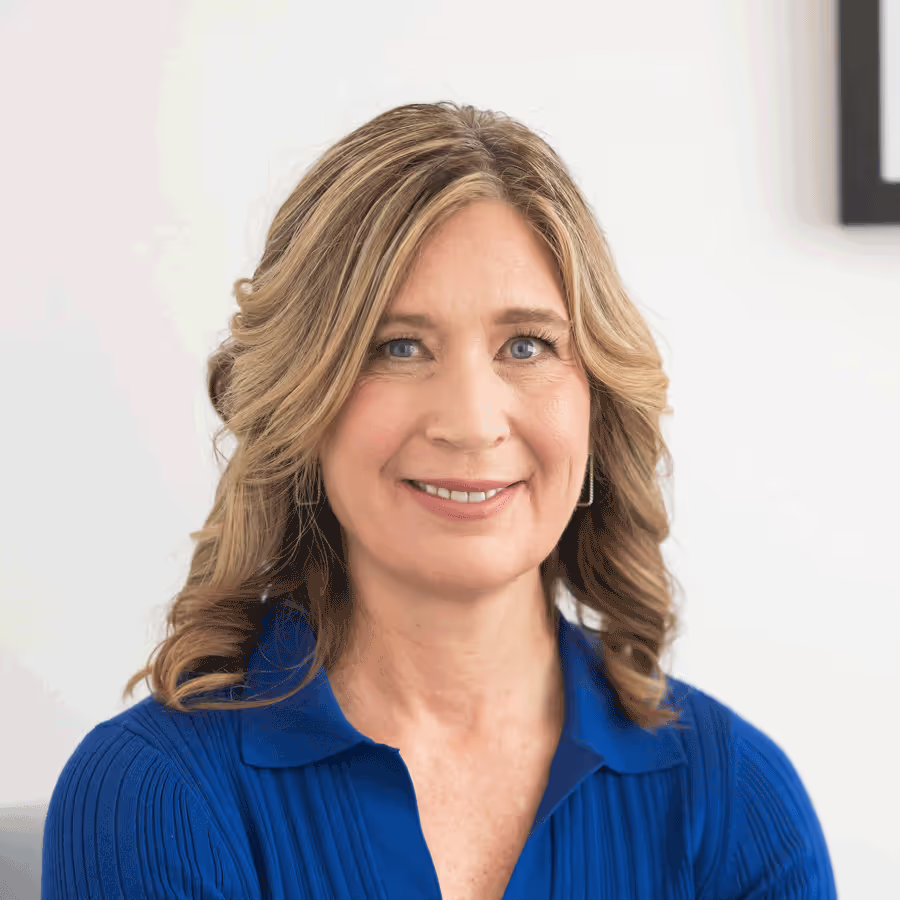
OT Barb Crowley spent 25 years in school districts across three states. Then she found something better. Here's what she told us.
Barb Crowley did not come to Coral Care looking for a side gig. She came looking for a way to keep doing the work she loves without losing the rest of her life in the process.
After 25 years as a school-based OT, a caseload that topped out at 70 kids, and a daily schedule that left her no time to send a parent a helpful article, let alone take a long weekend, she started asking a different question. Not "how do I get better at my job?" but "what would it actually look like if I built this on my own terms?"
She got her certifications in infant massage and tummy time. She started planning a private practice. Then she ran headfirst into the part she hadn't thought through: billing, marketing, and running a business solo. Not for her.
A Facebook ad changed things.
"I saw the Coral Care advertisement and I thought, wow. This seems like the best of both worlds. I can be an independent contractor, have flexibility, but I don't have to do the billing and the marketing."
— Barb Crowley, OT, Dallas TX
She joined. She hit a full caseload in six months. She now works Tuesdays, Wednesdays, and Thursdays, sees five patients a day, and has a three-day weekend to do whatever she wants with.
What the school setting couldn't give her
She loved that work. She was good at it. But she's also honest about what it cost her.
In the district, parent contact was minimal. Her team was teachers, diagnosticians, other therapists. She had five minutes with a family if she was lucky. And by the end, with 70 kids on her caseload, she felt like she wasn't serving them the way she wanted to.
In the home, that whole dynamic flips.
"The parents are the most invested people in the room. Working with them in their homes, you can see how the environment impacts the child. I feel like I'm making more of a difference than I was in the school setting."
— Barb Crowley
The other thing that changed: she went back to the research. New modalities, new approaches. She started exploring vibration plates. She followed her curiosity in ways she never had bandwidth for before. When you're not grinding through a 70-kid caseload, you have room to actually grow.
Her week, in her words
Barb works three days. She sees five patients each day, which she describes as "enough time to really connect with each family." Some of those kids she'll see for a few months while they knock out a specific skill. Others she expects to work with for years.
Fridays and Mondays are hers. She travels. She takes courses. She sends parents articles she finds on a Friday morning because she finally has the headspace to do it.
"I never felt like I had enough time to do that when I had a caseload of 70 kids. Now I can. That's not a small thing."
— Barb Crowley
What she tells parents
We spent part of the conversation just picking Barb's brain on pediatric OT, because she's been doing this for 25 years and she has things to say.
From a pediatric OT with 25 years in the field
- Most parents come in for behavior — not defiance, but dysregulation with an underlying cause they can feel but can't name yet.
- OT is not just for handwriting. Executive function, sensory processing, frustration tolerance, primitive reflex integration, emotional regulation. All of it.
- Early motor milestones matter more than most families realize. Crawling, reaching, tummy time. These build the foundation for how kids learn and regulate for years afterward.
- Kids need more unstructured play. Less scheduling, more parks, more movement. A lot of sensory motor goals get addressed just by letting kids be kids.
- Her icebreaker is always sensory. Balloons, bubbles, a dizzy disc. Once a kid is regulated, they'll work with you on anything.
What she'd tell a curious provider
We asked Barb what she'd say to a therapist who was thinking about making the leap but wasn't sure. Her answer was direct:
"Give it a shot. Talk to somebody at the company. Maybe talk to another provider. If you're tired of not having flexibility in your schedule, more freedom really does make you more motivated. I would have loved this when I first came out of grad school."
— Barb Crowley
She also had one piece of practical advice nobody told her going in: think carefully about your geography when you're building your caseload. It's easy in the beginning to just take whatever comes in. But if you end up with a client who's an hour away in stop-and-go traffic, and you don't want to let them go, you've made your own problem. Start intentional. Build in clusters.
What she wants next
Barb is at capacity. She's staying sharp, taking courses, and still thinking about opening up Mondays if the right kids come along. She told us she misses having colleagues — not in a wistful way, but in a practical one: the hallway conversations, the peer feedback, the lunch table energy. That's something we're working on.
In the meantime, she's exactly where she wanted to be. Still doing the work. Still learning. Just finally on her own terms.
25+
years of clinical experience
6
months to a full caseload
200+
sessions with Coral Care families
"I didn't want to quit working. I still love what I do. I just wanted my life back."
Ready to love what you do?
Join 500+ providers building their dream practice with Coral Care.
Apply Now