
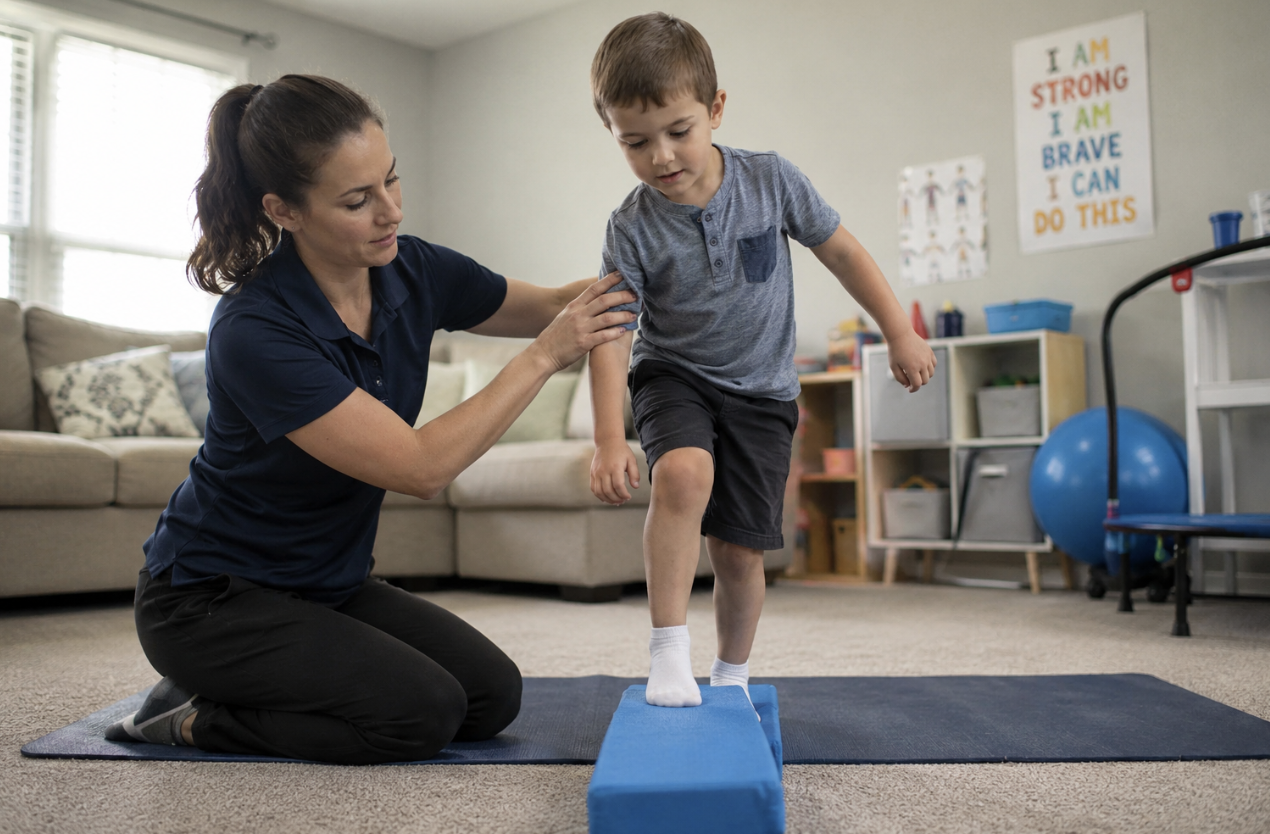
Physical therapy is an explicitly approved TEFA expense under Texas Education Code Section 29.3522. For pediatric PTs in Texas, TEFA represents a funded patient population that opens on July 1, 2026, when families can first access their accounts.
The PT caseload that TEFA unlocks skews toward the most complex cases: children with cerebral palsy, hypotonia, significant gross motor delays, and post-Early-Intervention children who aged out of free services and lost continuity of care. These are families who need intensive PT and have historically had difficulty affording it privately.
What the TEFA PT caseload looks like
Common TEFA PT referral profiles
- Cerebral palsy with qualifying IEP: up to $30,000 per year funds intensive PT that maintains function and prevents secondary complications
- Hypotonia: children who need higher-frequency PT than school settings provide, particularly in the 3-6 age range
- Post-EI continuity: children who received Early Intervention PT through age 2 and need seamless continuation after services end
- Gross motor delays that fall below school eligibility but affect daily function, sports participation, and playground access
- Persistent toe walking past age 3: Achilles tightness responds to early PT intervention; families who recognize this often seek private PT before the school system does
- Post-surgical rehabilitation where school-based PT cannot meet the required frequency
The $30,000 IEP tier is particularly significant for PT. Children with cerebral palsy or severe hypotonia who qualify for that tier can access 2-3 sessions per week of intensive in-home PT year-round. At typical in-home PT rates, that level of funding supports the kind of sustained intervention that changes long-term functional outcomes.
For children with CP or significant hypotonia, $30,000 per year is not a supplement. It is a caseload built around what they actually need.
Why in-home PT fits the TEFA population
PT goals for children with IEPs are inherently environmental. A child working on stair navigation needs to work on their stairs. A child building strength for playground access needs to practice in their backyard. Skills learned in a PT gym do not automatically transfer to the home environment, especially for children with motor learning differences.
The TEFA population — particularly IEP-level children with complex needs — benefits from in-home PT more than almost any other patient group. The session happens where the challenge is, with the furniture that is actually there, building the specific movements that life requires.
Documentation for TEFA PT billing
TEFA billing does not go through insurance and does not require PT-specific documentation formats beyond standard clinical practice. Sessions are confirmed through Odyssey after delivery, and Odyssey pays within 30 days. Your standard PT documentation — evaluation, treatment plan, session notes with functional outcomes — applies. There is no prior auth, no CPT filing to Odyssey, and no EOB.
Maintain your standard documentation in case TEA or Odyssey ever audits service delivery, but the billing workflow itself is simpler than insurance.
How to access TEFA families as a PT
Apply as a solo TEFA vendor
Register your practice as a Texas business entity, apply through the Odyssey vendor portal, complete individual fingerprinting clearance for each PT providing services, and submit PT service offerings for Odyssey review. Rolling applications, but the setup takes real time.
Join Coral Care
Coral Care is already an approved TEFA vendor in Texas with 200 registered therapists. PTs in our network skip the solo vendor application, receive fingerprinting instructions through onboarding, and have immediate Odyssey marketplace visibility when families search for PT providers.
Texas requires individual fingerprinting clearance for therapists serving children through TEFA. Coral Care sends fingerprinting instructions as part of PT onboarding. Your account moves from pending to approved once state clearance is confirmed — Odyssey cannot see fingerprint submission status directly, but the approval comes through the system automatically once cleared.
TEFA alongside commercial insurance
TEFA works alongside insurance, not instead of it. Coral Care accepts BCBS Texas, Baylor Scott and White, and Curative for PT. Many families will use insurance as their primary payer and TEFA for additional frequency or sessions beyond insurance limits. PTs in the Coral Care network have access to both payment paths for every patient.
The timing
TEFA families can first access their funds on July 1, 2026. PTs who are in the Coral Care network before that date are already visible in the Odyssey marketplace when families log in. For the post-EI population specifically — children whose EI services ended and whose families have been managing without PT in the interim — July 1 represents a real break in access. Being there when funds open matters.
Join Coral Care and start seeing TEFA families
Coral Care is an approved TEFA vendor in Texas. PTs in our network get immediate access to TEFA families, commercial insurance billing, and in-home caseloads across Texas.
Learn about joining Coral Care