
The OT licensure compact has a language problem, and it is costing clinicians time.
Thirty-four states have joined it. Eight are issuing privileges. Those are very different things, and a lot of OTs have read "my state passed the compact" and assumed they could start practicing across state lines. They cannot, not yet, and finding that out after accepting work is an expensive way to learn it.
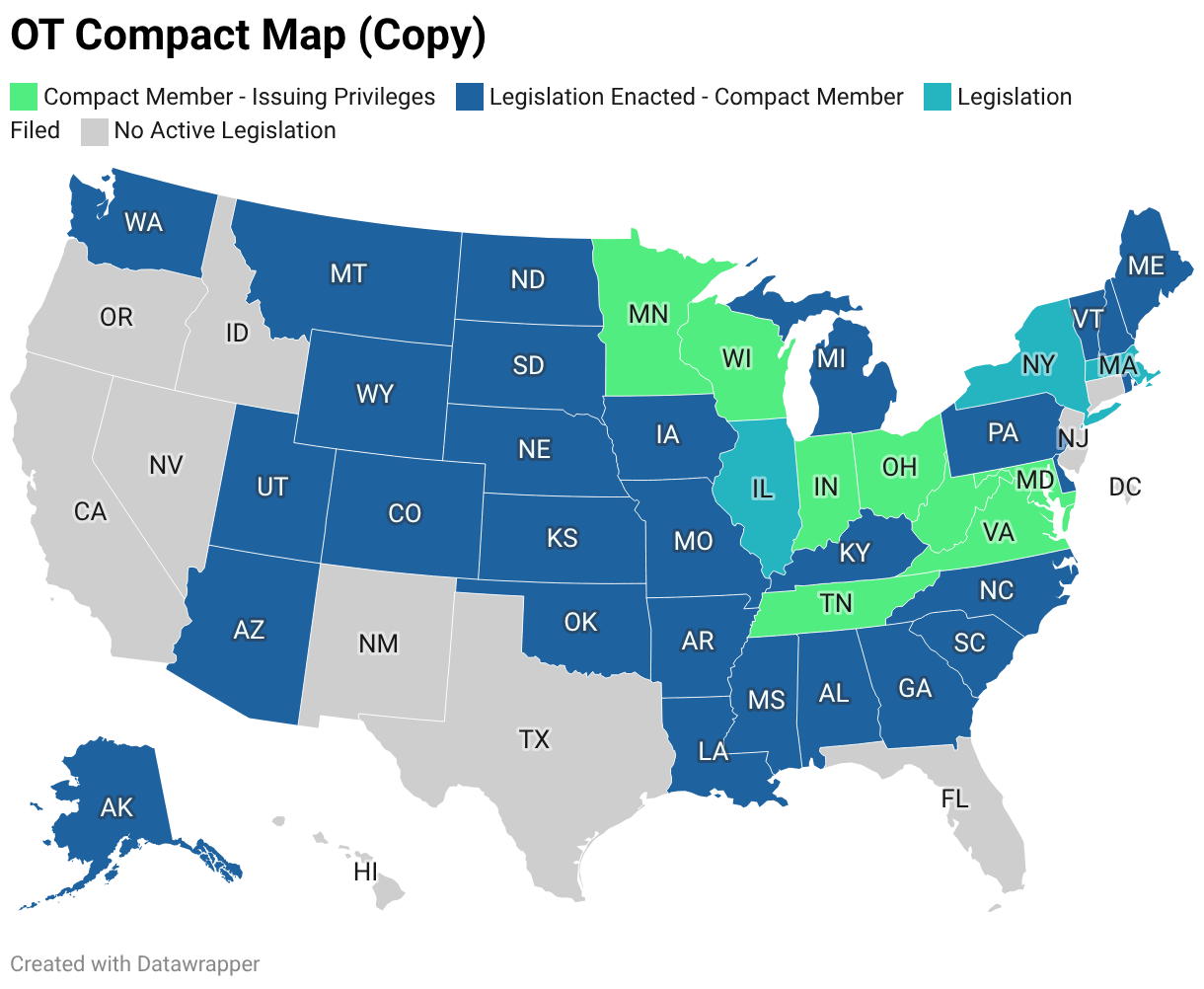
Here is the current picture, verified against the official compact map.
Last verified: August 15, 2026.
Key takeaways
- Only eight states are currently issuing compact privileges: Indiana, Maryland, Minnesota, Ohio, Tennessee, Virginia, West Virginia, and Wisconsin.
- Roughly 26 more states have enacted the compact but are not yet issuing. Passed is not live.
- To obtain a privilege you must hold a license in good standing in the member state where you reside, and that state must be one of the eight issuing.
- A compact privilege is equivalent to a license in the state where you use it.
- The list grows month to month as states finish technical integration, so verify before you rely on it.
What a compact privilege actually is
A compact privilege lets an OT or OTA who is licensed in one participating state practice in another participating state without applying for a separate license there. Functionally it is equivalent to holding a license in that state, including the obligation to follow that state's practice act and to answer to its board.
It is not a national license. It does not cover states outside the compact. And it does not exempt you from anything except the separate application, fee, and processing wait.
The four categories, and why the middle two confuse people
The official map sorts states into four buckets.
Issuing privileges
The compact is live. Residents licensed here can obtain privileges, and privilege holders can practice here. Eight states: Indiana, Maryland, Minnesota, Ohio, Tennessee, Virginia, West Virginia, Wisconsin.
Enacted, not yet issuing
The state has passed compact legislation and is a member, but has not finished the technical work of connecting to the data system and issuing privileges. About 26 states sit here, including Arizona, Colorado, Delaware, Georgia, Kentucky, Louisiana, Maine, Michigan, Missouri, North Carolina, Pennsylvania, South Carolina, Utah, Vermont, and Washington, among others. Nothing operational has changed for you yet if you live in one of these.
Legislation filed
A bill has been introduced but the state is not a member. Illinois, New York, and Massachusetts are here.
No active legislation
California, Texas, Florida, Oregon, Nevada, Idaho, New Mexico, Hawaii, New Jersey, Connecticut, and DC.
The gap between the first and second bucket is the whole source of the confusion. Thirty-four member states sounds like broad mobility. Eight issuing states is the reality you can actually work with today.
Who can get a privilege right now
This is the part worth reading twice.
You can obtain a compact privilege only if you live in, and hold your license in, one of the eight issuing states. Residency and licensure both, in the same state.
So an OT licensed in Ohio can get a privilege to practice in Virginia. An OT licensed in Pennsylvania cannot get one anywhere, even though Pennsylvania is a member, because Pennsylvania is not yet issuing. Being a member of the compact does not give you outbound mobility until your state activates.
Other requirements: your home license must be in good standing, you must meet the eligibility criteria published by the compact, and you will pay a fee per privilege state.
How to apply
- Confirm your home state is in the issuing group and your license there is active and in good standing.
- Check eligibility on the compact's Before You Apply page, which covers disciplinary history and other disqualifiers.
- Apply through otcompact.gov for the specific state or states you want, and pay the per-state fee.
- Read the practice act of the state where you will be working. The privilege gives you legal standing, not local knowledge, and documentation and supervision rules vary more than people expect.
- Track renewal against your home license. If your home license lapses, your privileges go with it.
Note that this is the OT compact only
Occupational therapy, physical therapy, and speech-language pathology each have their own separate interstate compact, with different member states and different activation timelines. Membership in one tells you nothing about the others.
If you are on a team where an OT has mobility and an SLP does not, that is why. Check each discipline's compact separately.
What this means for practicing across state lines
For clinicians who work where families live rather than in a fixed clinic, the state line is the practical constraint on your caseload. Someone working near the Ohio and Indiana border, or in the DC metro where Maryland and Virginia are both issuing, has real flexibility available right now. Someone in the Northeast largely does not.
At Coral Care we operate in nine states, and of those, only Virginia is currently issuing privileges. Pennsylvania is a member that has not activated. Illinois and Massachusetts have bills filed. Texas, New Jersey, and Connecticut have no active legislation.
Which means for most of our OTs, the compact is not yet a factor, and licensure in each state you want to work in is still the path. That is worth saying plainly rather than implying a mobility that does not exist yet.
Check before you count on it
States are activating at their own pace and the issuing list has grown steadily through 2026. The map at otcompact.gov is the authoritative source and it changes month to month.
This post was last verified on August 15, 2026. If you are reading it well after that, confirm your state's status directly before you make a decision based on it.
