“Should I Be Doing This With Her
Between Sessions?”
When a parent volunteers to be part of the work, the answer is not “just keep doing what you’re doing.” It is three specific things, embedded into routines they already have.
Fifth in a series on the real conversations Coral Care clinicians have with families.
This is the question you want every family to ask. It almost never gets asked the way you would script it. It usually comes out apologetically, at the door, with the slight worry of a parent who thinks they should already know the answer.
“I feel like I should be doing something with her between your visits. But I don’t want to mess it up. Am I supposed to be working on this with her?”
This is a parent volunteering to be part of the treatment plan. How you answer determines whether they actually become one or whether they go back to feeling like a passive observer for the rest of the case.
Most clinicians blow this moment by either being too vague (“just keep doing what you’re doing!”) or too prescriptive (a printed list of exercises that gets put on the fridge and never used). Neither one creates a partner. Here is what does.
The answer is yes, but with structure
The honest answer is yes, what happens between sessions matters more than what happens in them. The math is straightforward. You see this child for one hour a week. The family lives with them for one hundred sixty-seven. Therapy is not the thing. Therapy is the thing that teaches the family what to do for the rest of the week.
But “do more with her” is not a plan. A parent who is told to “practice her sounds” will try it twice, feel awkward, and stop. The structure matters more than the willingness.
The hour you spend with the child is not the intervention. The hour you spend coaching the parent is.
What good home practice actually looks like
A useful home plan has five properties. If any of them are missing, the family will not stick with it.
It fits inside a routine that already exists
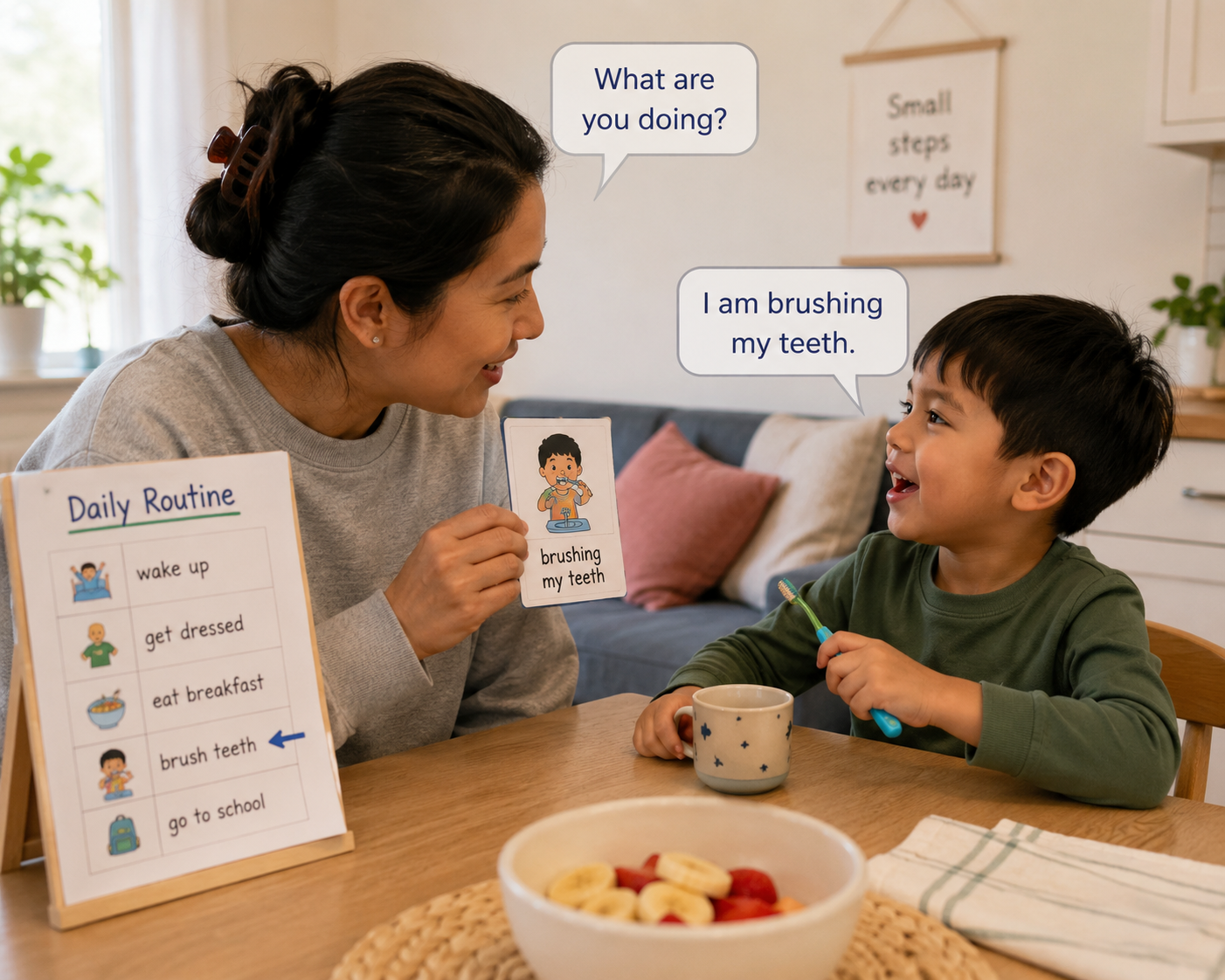
Not “set aside ten minutes a day for speech practice.” Nobody has ten minutes. It is “during bath time, when you are pouring water from the cup, name three things she is asking for and wait three seconds before giving them.” The practice rides along on a routine the family is already doing.
It is small enough to actually happen
Five reps a day, not fifty. Three exposures, not a worksheet. Most parents will not do thirty minutes. Most parents will do ninety seconds. Design for ninety seconds.
It is something the parent has already done with you in the room
If you have not modeled it for them and watched them try it, it is not really part of the plan. It is wishful thinking. Use the last ten minutes of a session for the parent to actually do the thing while you observe and adjust.
It has a clear success metric
Not “practice her /k/ sound.” It is “by the end of this week, I’d like her to produce a /k/ word during snack time three times.” The parent can come back next session and tell you whether it happened.
It does not involve drilling errors
For articulation kids especially: incorrect practice cements incorrect motor patterns. Coach parents on what NOT to do as carefully as what to do. “If she says it wrong twice in a row, move on. Do not ask her a third time.”
The pitfalls to warn them about
Even motivated parents fall into a few traps. Name them ahead of time so they do not blame themselves when it happens.
The drill instructor problem. A parent who watches a great session sometimes tries to recreate it at home as a structured drill. The child resists, the parent feels rejected, the practice stops. Tell parents that home practice should look nothing like a session. It should look like life with a small intentional layer on top.
The reward escalation. Bribery works once. The parent who promises a sticker for one good attempt is offering a pony by week three. Coach them to praise the attempt with words and warmth, not with material rewards that have to escalate.
The catch-all guilt. A parent who tries home practice for a week, has a bad week, and concludes they are a bad parent. Tell them, before it happens, that they will miss days. The point is not perfection. The point is more reps than zero, in the contexts where the skill needs to live.
The three-item rule
The single highest-leverage thing you can do at the end of any session is leave the parent with no more than three things to try during the week. Three is the magic number. Two feels light. Five is too many to remember. Three is what a parent can hold while making dinner.
Write them down. On a sticky note, in their notes app, in a brief recap email if your practice does that. Not a packet. Three things. Specific. With the routine they live inside.
“This week, I’d like you to: (1) wait three seconds before handing her the thing she points to, during snack and bath; (2) catch one /k/ word she produces correctly and repeat it back to her; (3) tell me on Thursday how it’s going.”
Three things. One concrete behavior, one observation, one touchpoint. That is the whole plan.
What this does to the relationship
When you turn the “am I supposed to be doing something” question into a concrete plan with five-reps-a-day, you change the parent’s relationship to the work. They stop being someone who watches their child receive therapy. They start being a clinician in their own home, in the most important hours of the week.
The kids who progress fastest are not the kids with the most talented therapists. They are the kids whose parents got coached well. That coaching is the work. Everything else is supporting cast.
What to leave them with
Next time a parent asks if they should be doing this with their child, here is the conversation:
- Yes, but only three things, and only this week.
- Here is what those three things look like inside routines you already have.
- We are going to practice the first one together right now, before I leave.
- I will check in on Thursday and adjust based on how it went.
That is a plan a parent can execute. That is a partner who will show up to the next session having actually done something. That is a child whose progress accelerates, because the seven days between visits have stopped being empty.
The parents who ask “should I be doing something” are giving you the most generous opening in pediatric therapy. Do not waste it on vague reassurance. Use it to build the partnership the kid actually needs.
Lindy Myers, M.S., CCC-SLP is the Clinical Lead at Coral Care. She has worked in pediatric speech-language pathology across school, outpatient, and in-home settings, and holds her Certificate of Clinical Competence from ASHA.
Bring this kind of conversation into your practice
Coral Care is a pediatric in-home OT, SLP, and PT network across nine states. We support clinicians in doing the work that actually moves families forward.
Learn about joining Coral Care