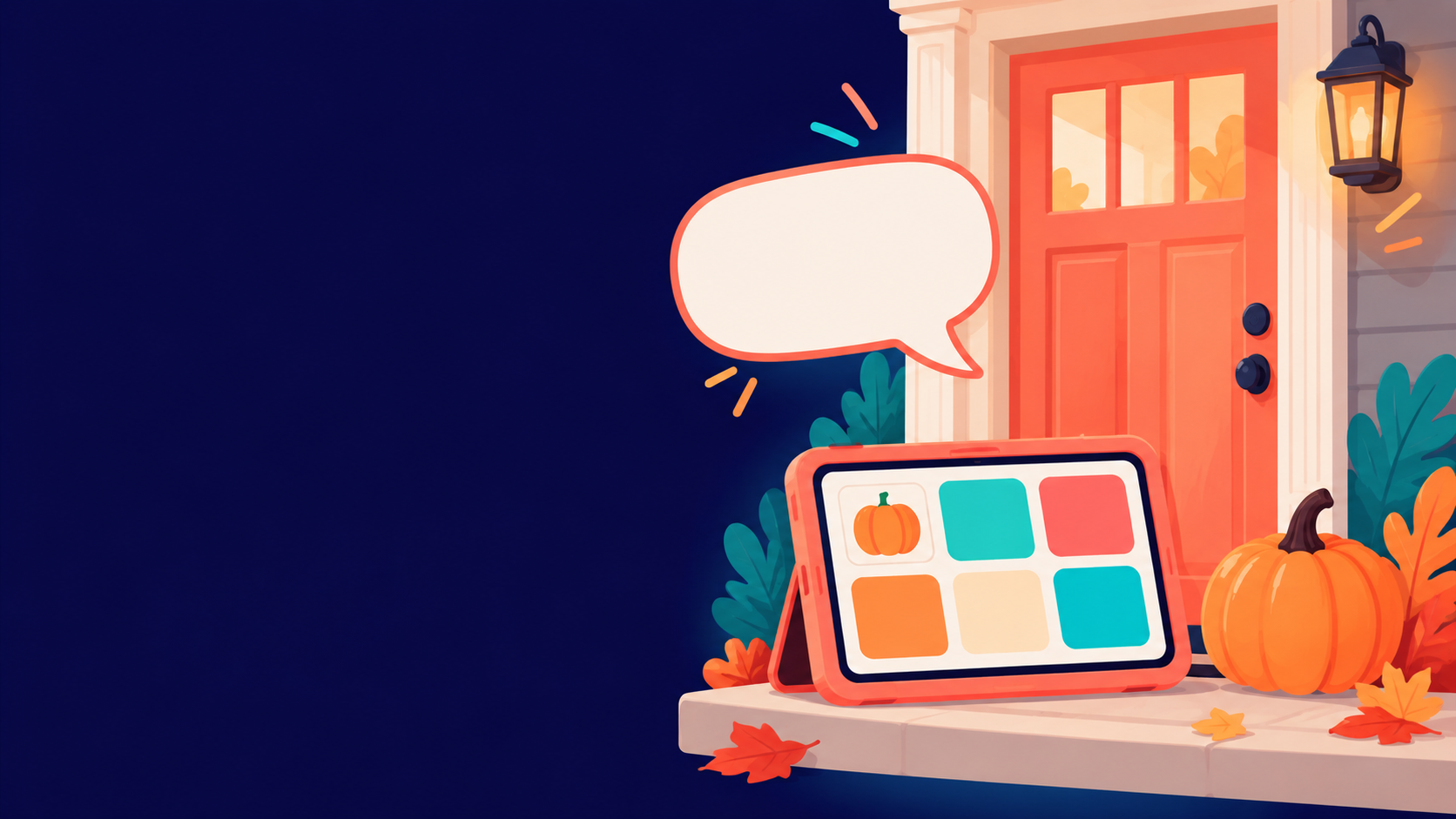
Trick-or-treating is a social language marathon. Greetings, requests, thanks, turn taking, and conversation with strangers, repeated at every door. When you see kids where they live, you can practice at the child's actual front door with the people who'll be there that night.
6 Halloween speech therapy activities
- Trick-or-treat role play. Family members play neighbors at the front door. Targets: greetings, requests, turn taking, communication across modalities (speech, AAC, gesture).
- Build-a-monster. The child describes a monster while a sibling or parent draws it. Targets: descriptive vocabulary, adjectives, sentence length.
- Mystery bag. Halloween items in a pillowcase. The child describes by feel or asks yes/no questions. Targets: expressive vocabulary, question forms, inferencing.
- Spooky sound hunt. Hide picture cards for target sounds ("boo," "bat," "witch") around the room. Targets: articulation in words and phrases.
- Costume conversation. "What are you going to be? Why?" Practice asking and answering with family members. Targets: WH questions, conversational turns.
- Halloween night retell. After the holiday, sequence what happened with photos. Targets: narrative skills, past tense, sequencing.
Trick-or-treat door scripts
- Start with one phrase at a time. "Thank you" is often the easiest win.
- If it fits the child, build toward a longer exchange: knock or ring, "trick or treat," "thank you," "Happy Halloween!" Keep it flexible. The child doesn't need to do every step at every door!
- Coach families that a wave, a sign, an AAC message, holding out the bag or a favorite line from a show all count. For gestalt language processors, a familiar script can be their greeting. The goal is a night that feels good to the child, however they participate.
- Practice with a real doorbell, look at masks, and try them on and take them off. Let the child set the pace.
AAC prep for Halloween
- Program "trick or treat," "thank you," and "I like your costume" on the device ahead of time (along with words for protest and regulation if they aren't already programmed, such as "all done," "too loud," "break," "scary").
- Add a "my costume is ___" button so the child can share.
- Consider a laminated backup card of the child's core board plus Halloween words, in case of low battery or rain.
- Model the device during role play, so the family sees how to support it at the door.
Social stories and visual supports
- Share a trick-or-treating social story with the family and personalize it with photos of the child, their costume, and their street.
- Read it together in session, then leave it for daily reading.
- Add a simple visual schedule for the night, like "costumes, houses, home" with an "all done" option the child can use anytime.
Making it count
- Document the skill, task, and level of cueing, not the Halloween theme.
- Hand off the role play to the caregiver partway through the session.
- Leave a one-line home program: "Practice the door script at dinner, 3 times, taking turns."
For a ready-to-use story families can print, send parents our trick-or-treating social story. For packing ideas, see What's in My Therapy Bag: Halloween Edition.
Why SLPs choose Coral Care
You get to practice language where it's actually used. Coral Care SLPs see kids in person, set their own schedules, and choose the areas they serve. We handle credentialing and billing.
Frequently Asked Questions
No items found.
