
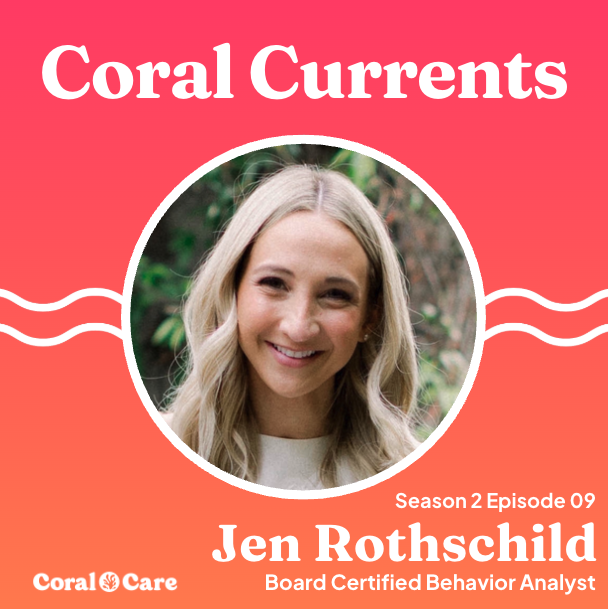
Let's be honest: this is the episode I've been both excited and nervous to make. If you're an SLP, OT, or PT, there's a good chance you've had a hard collaboration with an ABA team — or you've heard from autistic adults about the harm that compliance-based therapy caused them. At Coral Care, we believe those voices. That's exactly why I wanted to have this conversation.
In this episode of Coral Currents, I sat down with Jen Rothschild, a board-certified behavior analyst who started her career as a behavior technician and now leads training and development for clinicians at a telehealth ABA company. Jen practices from a neurodiversity-affirming framework, and she's candid about the fact that not everyone in her field does — and about what she was taught early in her career that she no longer believes.
We covered a lot of ground: what BCBAs and RBTs actually do, what supervision should look like (and why it often doesn't), and the structural reasons collaboration breaks down even when every provider wants it. We dug into the moments our providers ask about most — when another provider in the home is steering a family away from AAC, when stimming becomes a treatment target, when a child is earning every break in a 40-hour week. And Jen answered the hard provider questions directly, including the hardest one: how can ABA be neurodiversity-affirming when behavioral principles are at its core?
One line from Jen stuck with me: "The child experiences one nervous system across all therapy — our approaches should not feel fragmented to them."
My biggest takeaway is that curiosity opens doors that criticism can't. Jen offered specific questions any of us can bring to an ABA team: How are you supporting regulation before demands? What does assent withdrawal look like in your sessions? Can you tell me the rationale behind this goal? Those questions surface whether you're working with a true collaborator — and they advocate for the child either way.
This episode won't resolve every tension between our fields, and it isn't meant to. But if you share even one child with an ABA team, I think it will change your next conversation with them.
🎧 Tune in to Coral Currents on Spotify.
Resources to go deeper
Mentioned in the episode
- Shillingsburg, Hansen & Wright (2019), Rapport Building and Instructional Fading Prior to Discrete Trial Instruction (Behavior Modification) — the protocol Jen references for demand-sensitive kids: pairing first, demands faded in gradually
- BACB Ethics Code for Behavior Analysts (2022) — the collaboration and coordination-of-care requirements Jen cites (bacb.com)
- PEAK Relational Training System & Acceptance and Commitment Training (ACT) — the "new wave" frameworks Jen mentions
AAC
- Millar, Light & Schlosser (2006), The impact of AAC intervention on the speech production of individuals with developmental disabilities (JSLHR) — the research behind "AAC supports speech, it doesn't replace it"
- Romski & Sevcik (2005), Augmentative communication and early intervention: Myths and realities — a short, readable myth-buster, including the "prerequisites" myth
- The Communication Bill of Rights (NJC) — every person has the right to communication, no skills required first
- Project Core (project-core.com) — free core vocabulary modules; a great shared starting point for SLPs and ABA teams supporting the same device
- PrAACtical AAC (praacticalaac.org) — practical AAC strategies any team member can use
Regulation & stimming
- Autism Level UP! (autismlevelup.com) — Dr. Amy Laurent (OT) and Dr. Jacquelyn Fede (autistic self-advocate) offer free, practical regulation tools, including the Energy Meter. If your team is asking "what's the function of this behavior?", these tools help you also ask "what's this body telling us?" One of my favorites to share across disciplines — including with ABA teams.
- Kapp et al. (2019), "People should be allowed to do what they like": Autistic adults' views and experiences of stimming (Autism) — autistic adults in their own words on why stimming matters
Assent & trauma-informed practice
- Rajaraman et al. (2022), Toward trauma-informed applications of behavior analysis (JABA) — start here if you want to ask "what does assent withdrawal look like?" with confidence
- Autistic Self Advocacy Network (autisticadvocacy.org) — autistic-led advocacy, including the #StopTheShock campaign
PDA & demand sensitivity
- PDA Society (pdasociety.org.uk) — the most comprehensive hub on the PDA profile, including guidance for professionals
- Low-Demand Parenting by Amanda Diekman — written for parents, but a fast way for any provider to understand the low-demand approach
