
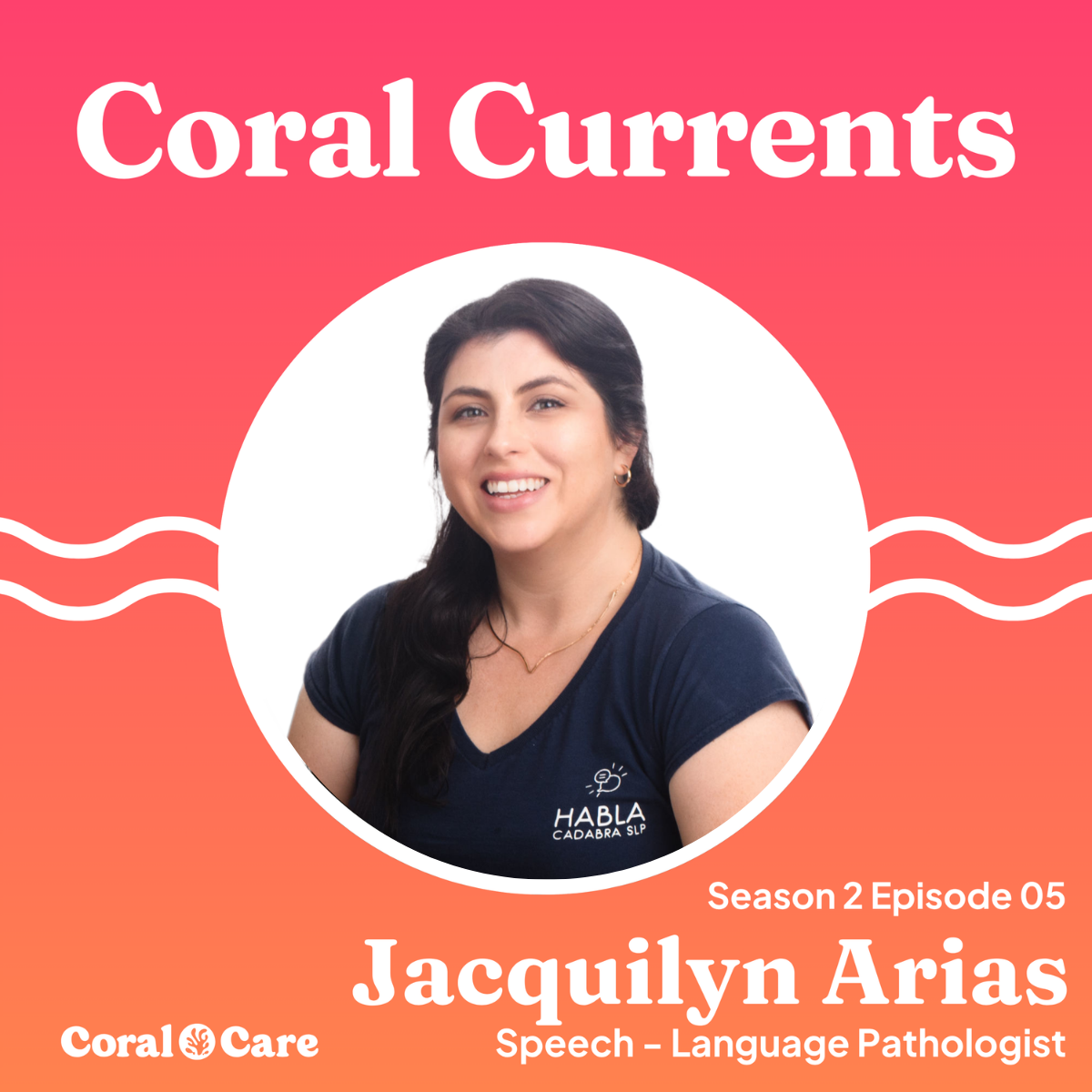
Most of us weren't trained to work with bilingual families. We were trained to work with children — and somewhere in that training, language was treated as a variable rather than an identity.
Jacquelyn Arias has spent her career in that gap.
She's the founder of Hablacadabra SLP, a practice and resource company she built with her co-founder specifically for Spanish-speaking families — not translated materials, not adapted worksheets, but resources designed from the ground up around what those families actually need, in the language they actually live in. She's also a Coral Care SLP who has worked across Houston, one of the most linguistically diverse cities in the country, with families speaking Spanish, Portuguese, Korean, Mandarin, and more.
In this episode of Coral Currents, Jacquelyn walks through what it actually looks like to honor both language and culture in pediatric speech therapy — and why those two things are not the same. Language is the code. Culture is everything underneath it: who talks to whom, what connection looks like in a given household, which relationships matter most, and what a family actually needs their child to be able to say.
She talks about evaluating bilingual children without defaulting to English as the baseline, writing goals around communicative function rather than linguistic code, and why code-switching isn't a problem to solve — it's a reality to build around. She gets into the metalinguistic piece too: how teaching a child the pattern of language, across both languages simultaneously, is often faster and more durable than targeting one at a time.
And she's honest about the limits of what any one provider can know. She doesn't speak Korean. She doesn't speak Portuguese. But she's learned that not speaking a family's language doesn't mean you can't serve them — it means you have to show up differently. You bring the visuals. You ask the parents to be your partners, not your observers. You get over yourself.
That last part is worth sitting with. Because I think a lot of us, when we encounter a family whose language we don't share, quietly decide we're not the right fit — or worse, we proceed as if the language piece is someone else's problem to solve. Jacquelyn makes a pretty compelling case that neither of those is acceptable.
This episode will change how you think about what it means to truly serve the families in front of you.
🎧 Listen to Coral Currents now
